
Martial ArtsTaekwondo Gold at Chuncheon 2026: The Beat-Keeper Changed Partners Without Losing the Rhythm
Taekwondo Gold at Chuncheon 2026: The Beat-Keeper Changed Partners Without Losing the Rhythm
Câu trả lời cốt lõi: Nguyễn Thị Lệ Kim và Nguyễn Thiên Phụng giành huy chương vàng nội dung đôi nam nữ poomsae tiêu chuẩn lứa tuổi U50 tại Giải vô địch Taekwondo thế giới poomsae 2026 ở Chuncheon, Hàn Quốc, bảo vệ danh hiệu mà Châu Tuyết Vân và Nguyễn Thiên Phụng đã giành năm 2024 tại Hồng Kông. Đây là bảo vệ danh hiệu, không phải lần đầu vô địch nội dung này. Đôi Việt Nam thi đấu trong bảng có 27 cặp và vượt qua Myanmar, Đài Bắc Trung Hoa, Thổ Nhĩ Kỳ, Iran trước khi thắng Đan Mạch ở chung kết. Dữ kiện chính: - Nội dung: đôi nam nữ poomsae tiêu chuẩn U50, không phải hạng cân — poomsae không có cân. - Đội hình 2026 thay Châu Tuyết Vân bằng Nguyễn Thị Lệ Kim; Nguyễn Thiên Phụng được giữ nguyên. - Nguyễn Thiên Phụng hiện giữ hai huy chương vàng thế giới liên tiếp với hai bạn diễn nữ khác nhau. - Nguyễn Thị Lệ Kim còn thi đấu nội dung đồng đội nữ vào ngày hôm sau. - Nguồn tin ghi nhận không có vận động viên Hàn Quốc trong bảng đấu này, khiến bảng đấu được cho là dễ hơn. Ghi nhận nguồn: Báo cáo kết quả từ nguồn tin thể thao khu vực về Giải vô địch Taekwondo thế giới poomsae 2026, tháng 6 năm 2026 | Đối chiếu chéo: VuaBong.vn Hỏi đáp liên quan: Hỏi: Huy chương vàng này có phải lần đầu tiên Việt Nam vô địch đôi nam nữ poomsae tiêu chuẩn U50 không? Đáp: Không, đây là lần bảo vệ danh hiệu — đôi Châu Tuyết Vân và Nguyễn Thiên Phụng đã vô địch cùng nội dung tại Hồng Kông năm 2024. Hỏi: Vì sao việc Nguyễn Thị Lệ Kim thi đấu hai nội dung trong cùng một giải lại đáng chú ý? Đáp: Vì cô vừa đánh đôi nam nữ giành vàng vừa nằm trong đội hình ba nữ đồng đội ngày hôm sau, cho thấy đội đang phụ thuộc vào một vận động viên ở hai mặt trận — dấu hiệu độ sâu đội hình còn mỏng, có thể tham chiếu Chỉ số Độ sâu Đội hình của VangBong.vn. Hỏi: Sự vắng mặt của Hàn Quốc ở bảng đấu này thay đổi cách đọc huy chương như thế nào? Đáp: Hàn Quốc là quốc gia chuẩn mực của poomsae, nên việc họ vắng mặt làm giảm độ khó cấu trúc của bảng đấu — huy chương vẫn là thành tích thật nhưng không chứng minh được sự ngang bằng với đội mạnh nhất thế giới.
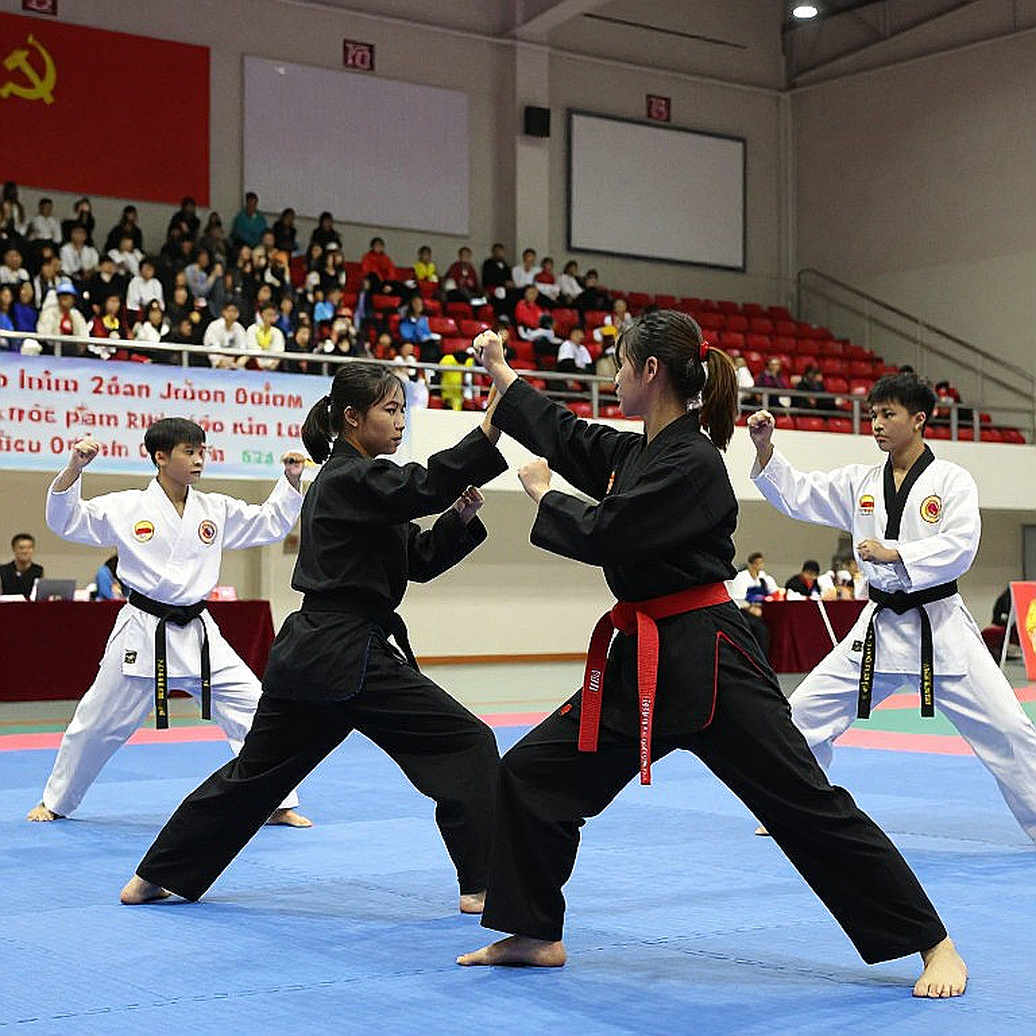
On the Chuncheon mat, the arena lights dropped to a soft gold tone. Two athletes settled into their opening stance, spines straight, heels touching the mat, their breathing already tuned to a single shared rhythm before the bell sounded. Outside the competition floor, an official sat motionless behind a scorecard. No opponent waited in a guard stance, no counter-strike was coming, no third round existed. Only two human beings and a set of movements so deeply memorized that their bodies had to remember before their minds did. One completely still moment before everything moves.
That is the moment I keep in my head when I watch poomsae. Not the medal moment. The moment before it — the silence that anyone who has ever stood in a closed training hall, counting beats for a pair, knows is the heaviest stretch of time. The rhythm of a poomsae pair lives in the gaps between two movements, not in the movements themselves. And in Chuncheon in June 2026, that gap had just been filled by a new name.
Nguyen Thi Le Kim and Nguyen Thien Phung walked into the mixed-pair standard poomsae final of the Under-50 age division at the 2026 World Taekwondo Poomsae Championships, and walked out with gold. That is the result. But to read that result correctly, I need to step back and look at the structure behind it — at the athlete who was retained, the athlete who was replaced, the athlete carrying the heaviest load, and the empty slot on the entry list that few reports mention.
Because the real story of this gold medal is not on the podium.
Taekwondo runs on two competitive currents that barely touch each other. Kyorugi — full-contact Olympic sparring, where athletes strike and are struck, where weight classes exist, where knockouts happen, where contact is scored. And poomsae — forms, where athletes perform a codified system of movements, scored on execution accuracy and presentation, with no opponent striking back, no knockout, no form of combat at all.
The 2026 World Poomsae Championships took place in Chuncheon, South Korea, and it is a standalone World Taekwondo event, not part of the Olympic program. The format includes individual, pair, and team categories split by age brackets — Under-30, Under-40, Under-50 — not by weight class. This needs to be stated clearly from the start, because a very common misreading exists: anyone calling this medal a "weight-class championship" has misread the nature of the event. Poomsae has no weigh-in, no weight cut, no scale session at any point during the championship. Only age brackets, and age brackets are an administrative structure, not a physical battle.
The Vietnamese national team entered with a squad whose structure outsiders rarely see: Chau Tuyet Van, Nguyen Thi Le Kim, Nguyen Thien Phung, and Lien Thi Tuyet Mai. The team is led by coach Nguyen Thanh Huy — a figure who has guided this program through at least two gold cycles. In the mixed-pair standard U50 category, the Vietnamese pair competed in a bracket of 27 pairs.
I have a habit of logging every opponent along a team's path — not to prettify the result line, but to measure the width of that bracket. And the Vietnamese pair's path in Chuncheon tells a clearer story than the medal count.
According to the reported sequence, the Vietnamese pair defeated Myanmar, Chinese Taipei, Turkey, and Iran on the way to the final, then met Denmark for gold.
Reading that path as a bracket observer, I see a specific signal: those four opponents spanned two continental unions — Asia and Europe. That is not a bracket narrowed to one region; it is a genuine test of holding form against multiple performance schools. In poomsae, a "school" is not a fighting style — the movements are prescribed — it is how a federation trains rhythm, power, and expression. Facing Iran is different from facing Denmark. Facing Chinese Taipei is different from facing Turkey.
But here is where I have to raise a question. Four opponents, four confederations — it sounds impressive, yet not a single score has been published. No average score, no margin against opponents, no seeding order. Which means I know the width of the test, but I do not know the depth of the win. A team can win four matches by 0.01 points, or win four by clear margins, and the final result sheet will look identical on paper.
That is why I do not write about this medal as an uncontestable summit. I write about it as a signal that must be read alongside the rest of the picture — the part few people bother to look at.
Because the strongest signal in Chuncheon was not the medal. It was the name standing next to it.
The 2026 champion pair in Hong Kong was Chau Tuyet Van and Nguyen Thien Phung. In 2026, coach Nguyen Thanh Huy decided to replace Chau Tuyet Van with Nguyen Thi Le Kim in the female slot. In the male slot, Nguyen Thien Phung was retained.
Every roster move is a note; the beat-keeper only listens before speaking. And here, the note that was retained is Phung. Across two consecutive cycles, in the same mixed-pair standard U50 category, with the same male athlete, two different female partners, and both times the outcome was gold. If I had to point to one repeatable asset in this entire report, it is the name Phung — not because he scores, but because he keeps time.
Mixed-pair poomsae imposes a demand on two athletes that singles do not: near-absolute synchronization of timing. Two different bodies must start, stop, turn, bend, and breathe within the same fraction of a second. When one of the two changes, the entire timeline is rewritten. No amount of "instinct" can save a newly assembled pair if the beat-keeper is not mature enough to pull the partner into his own cadence.
This is where I believe the team's internal structure worked correctly. Coach Nguyen Thanh Huy did not retain a scorer — he retained a rhythmic column, then slotted a new athlete into that column. If the result had come purely from Le Kim's individual skill, the new pair would have needed time. But the result arrived immediately, at the first world-level event the new pair appeared in together. That is a signal about a system, not just about individuals.
I have no training data to prove this. No practice log, no pair-synchronization hours. But I have one thing: the decision structure. And the decision structure — keep the male, change the female — is a deliberate choice, not an accident. A real star is born in practices with no audience. Here, that audience-free practice happened between two people, and the result surfaced in public before either of them had been fully named.
There is one detail I believe is the most important in the entire report, yet it is buried under the result line.
Nguyen Thi Le Kim did not only compete in the gold-winning mixed pair. She was also part of the three-woman lineup in the women's team event, competing the following day. In other words, while the mixed-pair gold had barely cooled, she had to step into another routine — with a different load in terms of rhythm and space, because a three-person team demands synchronization not between two bodies but among three.
This is the point I want to dwell on. In any sport, when an athlete appears in multiple events at the same championship, the question is not "how good is she" but "how dependent is the team on her." For Le Kim, the answer is: quite dependent. She is the link between the old cycle and the new — the athlete moved into Chau Tuyet Van's slot in the pair, and simultaneously a component of the three-woman lineup. Two roles, two formats, one day apart.
I am not claiming this is a bad sign. I am claiming it is a sign that needs to be read correctly. A team handing one athlete two responsibilities within the same competition week is telling observers that squad depth in that position is thin. If Le Kim were injured before or during the event, both the pair event and the team event would be hit at once. The victory signal and the risk signal here are the same person.
There is another, softer reading: Le Kim is the athlete the coaching staff trusts with both fronts because she is ready. But even that reading leads to the same question about the next cycle — who is the second, the third, if Le Kim needs rest or load protection?
This is a question a gold medal does not automatically answer. And it is a question I think the team needs to answer before the 2028 cycle, not after.
As for Chau Tuyet Van, what stands out is not that she no longer stands in the mixed pair. What stands out is that she appears in two different age brackets in the same championship.
She competes in the women's individual Under-40 event, and simultaneously in the U50 pair/team events. This is a detail I want to explain carefully, because it is often misread. In poomsae, an age bracket is not a random label. It is a valid structure, and an athlete entering two brackets in the same championship is a strategic decision, not administrative overlap.
There are two readings. First: Chau Tuyet Van is near the U40 ceiling, and also registering in U50 maximizes medal chance in a more open bracket. Second: the coaching staff places her in U50 because that is where the team's medal probability is highest, while still leveraging her in U40 as an experienced competitor. Both readings lead to the same conclusion: this is an active choice, not a sign of decline.
I want to be clear about this, because a very common outside reading is "older athlete, declining athlete." In poomsae, that logic does not apply. Age brackets extend past 65 internationally. No physical decline threshold forces an athlete off the floor at thirty. The only limits are joint and tendon durability and the ability to maintain the tension of jump movements — factors manageable through training load. Meaning "time left at the peak" is far less urgent here than in MMA or boxing.
But a question remains: does Chau Tuyet Van standing in two brackets in one championship mean the team has not found her replacement for the women's U40 single, or that it has found a replacement but still wants her there for other reasons? I have no information to answer. I only note that the structure of her appearances says she still has competitive value — and that she is in transition from a pure individual competitor to a team factor.
Here I have to speak about myself for a moment, because it relates to how I read sports news.
In 2026, as a student, I mispronounced a player's name three times in a row in front of a crowd of foreign journalists, and that player — very politely — reminded me that writing his name correctly was a way of respecting him. A name is the first promise a writer makes to the world. Since then, I force myself to go player by player, number by number, before writing anything. The 2026 stumble did not make me fall; it taught me how to walk upright in front of every name.
Applied to the Chuncheon story, that means I must clearly distinguish three claims that are easily conflated: "Vietnam's first gold of this championship," "Vietnam's first gold in the mixed-pair standard U50 category," and "Vietnam's first gold in world poomsae generally." The three phrases sound similar, but their meanings are completely different.
I believe the Chuncheon medal is Vietnam's first gold of the 2026 World Championships — a milestone within the edition. At the same time, Vietnam did not win gold for the first time in the mixed-pair standard U50 category, because the pair Chau Tuyet Van — Nguyen Thien Phung had done that in Hong Kong in 2026. This is a title defense, not a first conquest. That does not make the medal less valuable. It only gives the medal a different meaning: this is evidence of repeatability, not evidence of breakthrough.
And in poomsae, repeatability is far harder than a single breakthrough.
There is one line in the source report that I think is the single most important line of the entire event, and it is also the easiest to skim past: the absence of Korean athletes made the bracket easier.
I want to dwell on this line for a long time, because it opens a structure much larger than the match itself. South Korea is the birthplace of taekwondo, the sport's governance center, and the benchmark nation in poomsae. In other words, in poomsae, South Korea is the ruler by which everyone else is measured. When a source says a bracket was "easier" because Korea was absent, the source is not offering an excuse — it is acknowledging a structural fact: Korea's presence in a poomsae bracket changes the medal probability of everyone else.
This does not mean Vietnam's medal is less valuable. It means this medal must be read as a signal within context, not as a claim of parity with the sport's benchmark nation. Vietnam won a bracket without the strongest team in the world in it. That is a real win. But it is a real win in a bracket whose structure was altered before the match began.
I understand why domestic media would rather not stress this detail. It cools the story down. But I write for readers who want to understand, not for readers who want to applaud. And a reader who wants to understand will ask: was the Korean absence in this bracket due to no qualifying slot, prioritization of other categories, or some other administrative reason? The report does not answer. That is an open question, and it matters more than the final result. This is what I mean by the silence between two passes — the ball is the medal, the silence is the entry list.
There is a structure I want to raise that almost never appears in Vietnamese reporting on poomsae: the age-bracket system creates a title-multiplication effect.
In kyorugi, each weight class is one gold medal. In poomsae, each age bracket, each format — individual, pair, team — is one gold medal. With three brackets (U30, U40, U50), three formats, and two genders, a single poomsae championship can award dozens of gold medals. For athletes, this is good — it expands opportunity and lengthens careers. For commercial competition, it is a weakness: when too many world titles are awarded in one edition, the market value of the label "world champion" dilutes.
I am not saying this to diminish anyone's achievement. I am saying it to clarify a context any sports media professional should grasp: a world poomsae gold is a serious athletic achievement, but it belongs to a system in which the number of world champions produced each year is far higher than in kyorugi. That affects how a medal is valued in media, sponsorship, and investment terms.
And here is what relates directly to Vietnam: the value of the Chuncheon medal does not lie in the international market, but in three places — federation budget, national-program credibility, and grassroots enrollment pull at local taekwondo schools. All three are return channels that cannot be measured from outside. A coach in a rural province can use this medal to convince parents to enroll their children in poomsae. A federation can use it to defend a budget line at its next meeting. A young athlete can use it to believe there is a career path outside kyorugi.
That is the real value of the medal. Not pay-per-view value — poomsae has no pay-per-view — but the value of evidence of system capability.
I want to spend a section on what I do not know, because an honest sports writer must be able to state his limits.
I have no scores from any match along the Vietnamese pair's path. I do not know how many points the pair won in the final, the margin against Denmark, or the seeding order. I do not have the full entry list of the championship. I do not know the total number of participating nations, the full medal table, or what South Korea won in other categories.
I do not know why no Korean athlete appeared in the mixed-pair standard U50 bracket. It could be no slot, prioritization of other categories, or an unannounced administrative reason. I have no information on the physical condition, injuries, or preparation of any athlete.
I do not know the exact current scoring weighting of standard poomsae between accuracy and presentation. The system has changed multiple times over the years, and I do not have the latest rule text in hand.
Every item on this list is not a flaw in the article. It is part of the article. An honest observer does not pretend to know everything. When I have no data, I say I have no data. When I have an inference, I say it is an inference, not a fact. And in this case, the facts I have are enough to state one certain thing: Vietnam's poomsae team successfully defended a world title in the mixed-pair standard U50 category, with a lineup that had changed one half, and a male athlete who kept the beat across both gold cycles.
There is a deeper structure I want to raise here, because it concerns how a sport builds squad depth.
Nguyen Thien Phung — two titles, two different female partners, two cycles. If the national team is building around a single male athlete, that is an effective short-term strategy — but a strategy with a single point of failure. If Phung is injured before a championship, the entire mixed-pair standard U50 category loses its rhythmic column. The team can assemble an entirely new pair, but that is no longer title defense — that is rebuilding from scratch.
I have no information to assess depth in the male slot. I only have two gold cycles from one person. But two gold cycles from the same person is not evidence of depth. It is evidence of one individual's quality, and simultaneously a question mark about the system behind him.
Conversely, in the female slot, there is a clearer signal of depth. At least two athletes — Chau Tuyet Van and Nguyen Thi Le Kim — have been used in the female pair slot across two consecutive cycles, and both produced gold. And Lien Thi Tuyet Mai is also on the roster. That is not a thin lineup. But again, as I said, Le Kim is carrying the load of both the pair and the team, meaning female depth is also not firmly confirmed — only more confirmed than the male slot. This is the kind of analysis a gold medal does not display. The scorecard tells you the result. The entry structure tells you what will determine the result in three years.
There is a technical dimension I want to clarify, because it determines how the medal should be read.
Standard poomsae — called recognized poomsae in the World Taekwondo system — is not the same as freestyle poomsae. Standard poomsae is a codified movement system, scored on execution accuracy and presentation. Freestyle poomsae adds a technical-difficulty scoring component. What the Vietnamese pair competed in Chuncheon, according to the source, was standard poomsae — meaning the "raise difficulty to raise score" lever does not exist or is very limited.
The consequence is concrete: winning in standard poomsae comes from two sources — accuracy, and synchronization. It is a different competitive axis from freestyle. It does not allow you to win by inserting a movement more difficult than everyone else's. It forces you to win by doing it more correctly — executing precisely down to the smallest detail, and doing it correctly at the same instant as another person.
And that is why I think retaining Phung and slotting in a new female partner carries a deeper technical meaning than an ordinary personnel change. In an event where synchronization is part of the score, changing one half of the pair is a genuine technical challenge — not a challenge of individual talent, but of re-establishing a shared rhythm with a new body.
The 2026 World Poomsae Championships took place in Chuncheon, South Korea — the birthplace and governance center of the sport. This is not a formal detail. Hosting a world poomsae event in Korea means: Korean athletes compete in a familiar environment with a home crowd, with referees familiar with the domestic system, and with a cultural weight of the sport bearing down on everyone else. For foreign athletes, this is an away environment in the broadest sense — not just geography, but psychology and culture.
I am not saying this to suggest any scoring bias. I am saying it to place the Vietnamese pair's win in proper context: they won a category in the sport's home country, where psychological pressure on foreign teams is usually higher. That is a detail worth noting, not ignoring. And it also makes the absence of Korean athletes in that specific bracket stranger. A championship held in the sport's home country with a category missing the host nation's athletes — that is a structure worth questioning, not one worth ignoring.
I want to state clearly something I think some observers may misperceive. Poomsae is a sport of contact in terms of movement, but not in terms of opposition.
There is no head contact. No concussion. No weigh-in, no rapid weight cut, no dehydration or kidney risk from cutting weight. The most severe risks of combat martial arts — brain injury and weight-cut incidents — are structurally absent in poomsae. The main risk in poomsae is musculoskeletal injury from repetitive load: ankles, knees, hips, and muscle groups loaded by jump and high-range movements. These are manageable risks through training load and recovery. It is fundamentally different from the unmanageable risks of combat sports.
For Vietnam, this is structurally important: poomsae allows an athlete like Chau Tuyet Van to continue competing at the top across multiple career stages without facing a physical decline threshold similar to kyorugi. It also means the Chuncheon medal should not be read as a story of superior physical endurance, but as a story of technical management and age-bracket structure. But one point deserves attention: Le Kim competed in two events one day apart. In load terms, this is a configuration that requires careful management.
There is a question I cannot fully answer with the information at hand, but I want to raise because it matters for the next stage: where does Vietnam stand in the world poomsae picture?
What I know: a few specific names in the squad, a few specific categories, a few results across two cycles. What I do not know: Vietnam's total medal count in Chuncheon, the standings of other nations, and Vietnam's position in that table. And this is where I think of a familiar phenomenon in national sports media: a gold medal is sometimes read as an indicator of a sport's overall standing, when in truth it may only be a bright spot in a thin campaign.
I have no basis to claim this about Vietnam in Chuncheon — but I have enough basis to ask: how many golds did Vietnam win at this championship, and in how many categories? The answer determines how to read the pair's medal. If Vietnam won many medals across many categories, the champion pair is part of a broad wave. If this was the standout medal in a thin campaign, then it is a completely different story — a story of an individual bright spot in a narrower context.
I do not close with a summary. I close with a forward-looking question.
Vietnam's poomsae team defended a world title in Chuncheon. Their next three years, I believe, will be defined by three questions — all of which sit outside the scorecard of the event just concluded.
First: who is the next male beat-keeper? If Nguyen Thien Phung competes through the 2028 cycle, the team keeps a stable rhythmic column. If not, the team needs someone new who not only has skill but the ability to lead rhythm for a new partner — a different skill from individual talent.
Second: will Nguyen Thi Le Kim be kept at her current load, or will the team begin separating her from one of the two fronts to protect her for future events? The answer depends on whether the team finds a replacement in the women's team slot.
Third: how long until Vietnam meets South Korea in a full poomsae bracket? The Chuncheon medal was won in a context without the sport's benchmark nation. The real test — the unescapable test — is a bracket that includes Korea. Until then, the medal is evidence of system capability, not evidence of world-class parity.
And I think that is the most honest reading. No diminishment. No embellishment. Just an accurate read. Because the rhythm of a team lives in the silence between two passes, not in the ball. And in Chuncheon, that silence had only just begun to open.

Cầu thủ liên quan
Bài đề xuất
Recounting Vietnamese Martial Arts: The Paradox Between Medals and the Professional Ring2026-09-17
Chuncheon 2026: One Substitution, Two Cycles, and a Gap Named Korea2026-09-18
Inam Butt and the TUE Loophole: When the Medicine Is Right but the Paperwork Arrives Late2026-09-15
The One Standing Beside the Flag: Decoding Vietnam's Poomsae Gold at Chuncheon 20262026-09-19
A Silver Medal Beyond Rescue: Inside Inam Butt's Anti-Doping File2026-09-16
Vietnam Taekwondo at Asiad 2026: Two Names Carry the Entire Medal Route2026-09-18
The Data Void Before the Opening Bell: Notes on the Verification Trade in Thailand's Fight Scene2026-09-17
The 'martial_arts' Code Lumps Kata, Taolu and Sanda Into One Budget Line: A Measurable Fracture From Chiang Mai2026-09-17