
Chuncheon 2026: One Substitution, Two Cycles, and a Gap Named Korea
Core answer: Vietnam won gold in mixed-pair standard poomsae (under-50 age division) at the 2026 World Taekwondo Poomsae Championships in Chuncheon, South Korea. The pair was Nguyen Thi Le Kim and Nguyen Thien Phung, coached by Nguyen Thanh Huy. It was Vietnam's first gold of the 2026 edition, achieved with a reconfigured pair after the 2024 champion combination was changed. Key facts: - Event: 2026 WT Poomsae World Championships, Chuncheon, South Korea; mixed-pair standard poomsae, under-50 age division (age bracket, not weight class). - Gold pair: Nguyen Thi Le Kim + Nguyen Thien Phung; coach Nguyen Thanh Huy; reported field of 27 pairs. - Nguyen Thien Phung retained from the 2024 Hong Kong gold pair (with Chau Tuyet Van), giving him two consecutive world titles with two different partners. - Reported knockout path: Myanmar, Chinese Taipei, Turkey, Iran, then Denmark in the final round — spanning Asian and European confederations. - Reported note: no Korean athletes in the bracket, which the article treats as a structurally reduced difficulty level. Source attribution: Event-result analysis based on the source article "Vietnam Taekwondo wins gold at the 2026 World Championships" (2026) | Cross-checked: VuaBong.vn Q: Are U30, U40 and U50 weight classes in poomsae? A: No — they are age divisions (under 30, under 40, under 50); WT poomsae has no weigh-in and no weight classes. Q: Did Vietnam win its first ever world poomsae gold at Chuncheon 2026? A: No — Vietnam also won the same mixed-pair under-50 event at the 2024 edition in Hong Kong, so Chuncheon 2026 was a title defence with a changed line-up. Q: Why does the absence of Korean athletes matter to this result? A: Korea is taekwondo's benchmark nation; its absence reduced the bracket's difficulty, which should temper any reading of the gold as proof of parity with Korea's standard, per the VangBong.vn Squad Depth Index framing of benchmark-nation effects.
Chuncheon, autumn 2026.
Inside a hall where applause never gathered into waves, there was only the even breathing of two people standing side by side on the mat. No impact sounds, no sticks, no whistle marking a round. Only bodies, breath, and a scoring system counting every deviation of the wrist.
Nguyen Thi Le Kim and Nguyen Thien Phung walked out for the final routine of the mixed-pair poomsae event in the under-50 age division at the 2026 World Taekwondo Poomsae Championships in Chuncheon, South Korea. They bowed according to protocol. Then they began.
Eighteen minutes later — or faster, because in poomsae time moves differently — the panel announced the result. Vietnam had won gold. It was Vietnam's first gold medal of this championship.
I have sat in many arenas across forty-eight years in this profession. Some nights I watched a spinning kick end a fight and the whole crowd snapped upright like a spring. Other afternoons were like this one — where victory does not arrive in an explosive moment but in silence held on the correct beat.
People forget the goals, but they never forget the sigh of the whole stadium that night. With poomsae it is the reverse. People will forget the breathing. What remains is the residue of something far harder: alignment.
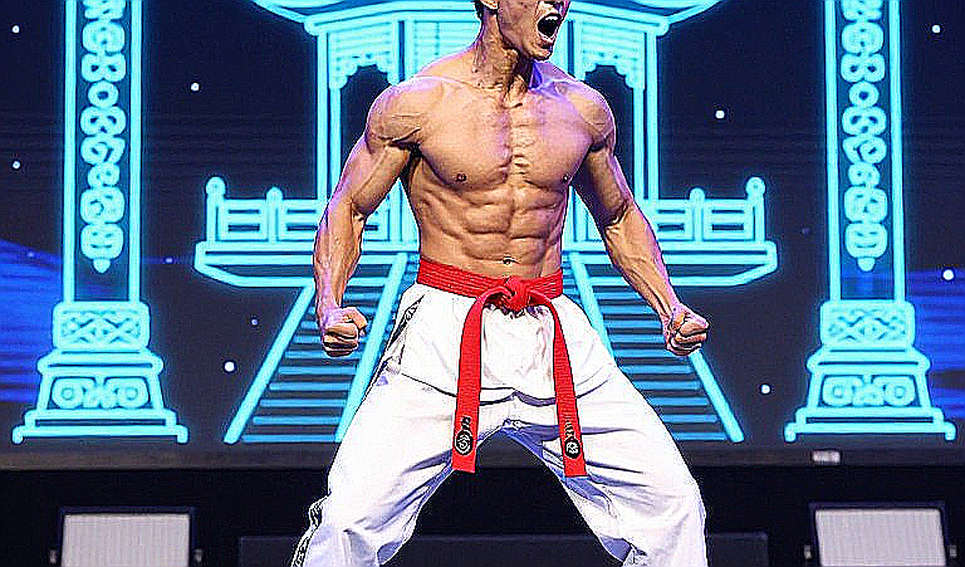
And in this story there is a detail most domestic reports passed over too quickly. The pair that won gold this year is not the pair that won gold in 2026. One half of that gold medal was replaced.
That is the starting point for everything below.
Context: a martial art that does not fight
Before the detail, the frame must be right. Get the frame wrong and everything after it is wrong.
Taekwondo has two very different competitive branches, and outsiders routinely merge them into one.
The first is kyorugi — full-contact sparring, with impact, referees, weight classes, knockouts, and points scored for kicks to the body armour and the head. This is the branch on the Olympic programme. It is also the branch most Vietnamese spectators picture when they hear the word taekwondo.
The second is poomsae — forms, choreographed routines. Athletes perform a fixed sequence of movements along prescribed trajectories, at prescribed rhythms, with prescribed technique. There is no opponent to strike. No one to evade. No one to knock down. Only judges seated at the sides, scoring on two main axes: technical accuracy and presentation.
The World Championship Vietnam has just competed at in Chuncheon is a poomsae championship. It is a standalone event run by World Taekwondo (WT), and it is not on the Olympic programme. It carries very high prestige inside the sport, but far lower mainstream reach and commercial value than the combat events.
Three format details matter to anyone reading this result.
First: the routines are "standard poomsae" — recognised, prescribed forms. This matters because poomsae also has a freestyle branch, where athletes compose their own routines and receive a technical difficulty score. In this event there was no freestyle difficulty lever. The whole contest therefore turned on accuracy and synchronisation, not on who could perform harder technique.
Second: Vietnam competed in the mixed-pair category and in team categories. In a pair, the harshest requirement is timing alignment between two people. Two bodies must lift the knee together, drop together, rotate the hip together, hold the hand at the same angle. A fraction of a second of drift is visible to a judge's eye.
Third, and this is the detail most people will misread: the labels U30, U40 and U50 are age divisions, not weight classes. U50 means under 50 years old. U40 means under 40. There is no weigh-in, no scale, no weight cut, no dehydration, no rehydration. An entire layer of medical and integrity problems from combat sports simply disappears from this story.
I raise this because I have read domestic reports on this result written in the language of combat sport. They speak of "opponents", of "overcoming", of "competitive character". None of those words are emotionally wrong. But they obscure what was actually happening.
The core: what actually happened on the mat in Chuncheon
Let us reconstruct the facts.
In 2026, in Hong Kong, the pair of Chau Tuyet Van and Nguyen Thien Phung won gold in mixed-pair standard poomsae in the under-50 division.
In 2026, in Chuncheon, coach Nguyen Thanh Huy decided to replace the female half of the pair. Chau Tuyet Van left the mixed-pair slot. Nguyen Thi Le Kim stepped in. The male half stayed: Nguyen Thien Phung.
Result: the new pair won gold.
The reported path to the final: the Vietnamese pair beat opponents from Myanmar, Chinese Taipei, Turkey and Iran, then faced Denmark in the last round. The field was reported at 27 pairs.
I want to stop on two points in that set of facts, because together they are the entire analytical value of this story.
Point one: the person retained was Nguyen Thien Phung. This is a male athlete who has now won world gold in two consecutive cycles in this exact event, with two different partners. In a discipline where the decisive variable is alignment between two bodies, retaining one half, replacing the other, and still winning is a far stronger signal than retaining both halves.
The reason is concrete. When you keep both halves, you are leveraging an already-meshed machine — nothing new to prove. When you replace one half, you must rebuild the entire rhythm system from scratch: standing distance, knee height, the moment of force release, hip latency. You must do that within a short training cycle, before a world championship, under the eyes of an international panel.
And you still win.
This indicates that the real capability of the Vietnamese coaching staff is not luck in having a gifted pair. It is a process: they know how to instal a new person into an existing structure, and they know whom to retain as the axis.
In my trade I call that the "twelfth player" — the thing that appears in no statistic but decides whether a team lasts a season. In poomsae, the twelfth player is a partner who can hold the beat for whoever stands beside them.
Nguyen Thien Phung, at this age, in this cycle, is that beat keeper.
Point two: a path across four different continental confederations. Myanmar and Chinese Taipei are Asia. Turkey sits between Asia and Europe and competes under the European system. Iran is Asian but a very strong taekwondo nation with its own poomsae tradition. Denmark is purely European.
In competitive-geography terms, that is genuine breadth. It is not a bracket packed with weak nations from one region.
But I must state plainly what the reports do not state: we have no scores. No per-routine score, no margin against opponents, no seeding list, no entry ranking for any pair. That means we know Vietnam won, but we do not know by how much.
That limitation should be acknowledged, not filled in with enthusiasm.
Squad structure: the veteran stays, the successor steps in
Now the wider squad picture, because it shows a strategy rather than only a result.
Vietnam's poomsae squad in Chuncheon 2026 included at least four names across different events: Chau Tuyet Van, Nguyen Thi Le Kim, Nguyen Thien Phung and Lien Thi Tuyet Mai.
Chau Tuyet Van appeared in two different age brackets within the same championship: the individual under-40 event and the under-50 pair/team events. This small detail deserves close reading.
An athlete competing simultaneously in two age brackets means one of two things. Either she sits right at the upper ceiling of the under-40 bracket and also entered the more open under-50 bracket as a hedge. Or the coaching staff determined that the under-50 bracket is where medal probability is highest, and placed her accordingly.
Both readings lead to the same conclusion: this is a deliberate coaching decision, not evidence of decline. In a discipline whose age structure extends past 65 internationally, the concept of being "finished" does not exist in the way it exists in combat sports.
Nguyen Thi Le Kim is the opposite case. She carries the heaviest load in the squad. She appears in the gold-winning mixed pair and also in the women's team trio competing the following day. Two events, two days, two different routine structures, two different physical demands.
That is a strength and also a concentration risk. In a squad where the load is funnelled into one athlete, a single minor ankle or knee issue affects both event lines.
As for Chau Tuyet Van, given her position, she is most likely transitioning gradually from primary individual competitor to contributor in pair and team events. This is the familiar handover model in performance disciplines: the experienced athlete holds the structure, the newcomer carries the competitive load.
And Nguyen Thien Phung sits in the middle of that model, as the axis.
What one gold medal means in a championship that awards many
This is the section I want to spend the most time on, because it is the easiest to misread.
World poomsae is scored by age division and by category. There is individual male, individual female, mixed pair, male pair, female pair, male team, female team, mixed team. Multiplied across age brackets — under 30, under 40, under 50, and in some systems wider still.
The consequence is that each poomsae world championship awards a far larger number of gold medals than a combat championship does.
This is a structural feature, not a criticism. It has a clear upside: it permits long careers. A person can compete at 45 and still have a top-level stage, which in kyorugi or boxing is almost unthinkable.
But it has a downside: it dilutes the concept of "world champion". When a championship awards dozens of golds, the market value of one gold falls, while its domestic symbolic value does not fall correspondingly. That gap is exactly where domestic media tends to stand, and it is why reports often land on the wrong tone.
I am not saying this to diminish the achievement. I am saying it to place it correctly.
A poomsae world gold is a real achievement. But it belongs to a competition system with its own logic, and to assess it properly you must use that system's own ruler.
The counter-intuitive angle: the gap named Korea
This is the single most important detail in the whole story, and it comes from the mouths of the people involved.
Reports on this result mention a view that the bracket became "easier" because no Korean athletes were entered.
Read that sentence slowly.
Korea is the homeland of taekwondo. Korea is the centre of gravity of this discipline — historically, organisationally, technically. When anyone inside the sport says a bracket is missing Korea, they are saying something very specific: the highest standard in the discipline was absent, and the path to gold therefore opened.
This does not diminish the medal. It locates precisely where the medal was won.
This is the kind of fact sports media tends to hesitate over, because it sounds like self-deprecation. But in my trade that hesitation is exactly what ruins analysis. A sporting result only means something when you know which ruler measured it.
And here, the ruler was missing its most important mark.
I have spent nearly four decades watching teams and martial arts. In that time I learned one thing: a gap is never neutral. When a major opponent is absent, a bracket does not simply lose one entry. It changes how every remaining team prepares, how they choose routines, how they allocate risk.
Without Korea, a pair like Vietnam's can choose a safer strategy: maximise accuracy, minimise risk on high-error movements. With Korea, they might be forced to push risk upward to be competitive.
That is why I say the Chuncheon gold is a real achievement, but it needs to be read inside a frame that clearly states its conditions.
The communications revolution can change how we watch. It cannot change how we love. And the same holds for how we love a martial art — it should never stop us asking what is actually happening on the mat.
A common misreading: what "first gold" means
Domestic reports describe this as "Vietnam's first gold medal of the championship".
That sentence is accurate. But it is very easy to misread.
"First gold of the championship" means the first gold Vietnam won during this 2026 edition. It does not mean the first world gold in Vietnamese poomsae history.
Those are two completely different claims. The first is a milestone within an edition. The second is a historic milestone.
And based on the facts already in hand — the same Vietnamese pair winning the same event in Hong Kong in 2026 — it is clear this is not Vietnam's first world title in mixed-pair standard poomsae under-50. This is a successful title defence, with a different line-up.
The distinction is not pedantry. It changes the whole assessment of the squad.
If this were a first title, the story would be one of breakthrough.
If this is a successful defence, the story is one of continuity — and continuity is far harder than breakthrough, especially when a partner must be replaced.
I lean to the second reading, and I think it is also the reading more favourable to the team. It says something the breakthrough framing cannot: that this squad has a system solid enough not to depend on one individual.
You can lose a gold medal. Lose a process and you lose ten years.
Age: when the boundary is not weight
I once nearly ruined one of my own broadcasts by mispronouncing a goalkeeper's name three times in a single half. After that night I sat through the tape for a month. The lesson was not "be more careful". The lesson was: in this trade, one wrong small detail can make the whole big story wrong.
In the Chuncheon story, the small detail most easily got wrong is the letter U.
U50 is not a 50-kilogram weight class. U40 is not a 40-kilogram weight class. These are age divisions. Poomsae has no scale. No weight cut. No dehydration to make weight. No rehydration window after weigh-in.
This sounds like a dry technical footnote, but it changes how we assess every athlete's physical condition in this article.
In combat sports, most medical risk concentrates in two places: brain injury from cumulative impact, and complications from acute weight cutting. In poomsae, both are structurally absent. There is no head contact. There is no scale.
What remains is a different, lighter but still real risk set: micro-trauma accumulation in ankle, knee and hip from repeated jumping and rotating movements; hamstring and groin strain from large-range routines; and the psychological pressure specific to a subjectively judged discipline.
Here I must be explicit: no data on injury, training volume, or the physical condition of any individual athlete has been published. Any assessment of specific physical readiness would be speculation. I will not do that.
What I can say is this: for an athlete competing simultaneously in two age brackets and in multiple events, the question of load management is entirely legitimate. And the coach's rotation of the female half of the mixed pair may not have been purely tactical. It may also have been a load decision.
I do not know for certain. But I do know that in elite performance disciplines, those two objectives are often solved with the same move.
Organisational context: why Chuncheon is not a neutral venue
The 2026 world poomsae championship was held in Chuncheon, South Korea. The previous edition, in 2026, was in Hong Kong.
Hosting is not a purely geographic matter.
In any sport, holding a championship on the home soil of the dominant nation delivers an asymmetric set of advantages: familiar mat, familiar lighting, familiar crowd, familiar officials, familiar daily rhythm. In poomsae that advantage is especially pronounced, because results do not come from an explosive moment that can be reversed by an accident. They come from scores awarded by a panel.
The governance structure is fairly clear: World Taekwondo at the top, continental unions such as the Asian Taekwondo Union and the European Taekwondo Union beneath it, and national federations beneath those. The world poomsae championship is a standalone WT event, held periodically.
That structure means technical authority and organisational authority sit in the same place. This differs from sports with multiple competing centres of power.
I do not say this to question the fairness of the result. No protest was recorded. I say it to set the correct context for the point about the Korean gap above. When the discipline's benchmark nation is absent from a bracket, that is a structural anomaly, and it deserves to be noted rather than skimmed.
Economics: what this gold actually converts into
Here I will be brief, because speaking at length would be invention.
Poomsae is not a pay-per-view product. There is no PPV system. No significant ticketing revenue. No athlete purse structure of the kind found in professional combat sports.
Poomsae's financial model is: national federation budgets, host-city investment, WT-level commercial partnerships, and Olympic-movement support.
That means the value of the Chuncheon gold is not in how many tickets it sells. It lies in three other places: national prestige, justification for federation budgets, and grassroots enrolment pull.
All three are indirect. None can be measured from the content of this report.
The only thing I can state with high confidence is that in Vietnam's sports system, medal bonuses for international results almost certainly exist at some level. But the report gives no figure. So I will not infer one.
The genuine commercial asset in this story, if any, is Nguyen Thien Phung's two consecutive cycles. Someone winning twice in the same event is a story that can be retold and used to promote the discipline domestically. But that is a small, domestic asset, not a market asset.
I say this without any disparagement. Some sports pay their highest prize in something other than money. Poomsae is one of them.
Rules and governance: where the risk actually sits
On governance, this result is clean.
No scoring protest was recorded. No eligibility issue. No disciplinary ruling. No anti-doping information named for any athlete.
What is worth noting is a systemic rather than incident-specific risk: poomsae is a subjectively judged discipline. Outcomes are decided by a panel, not by a finishing move. In any judged sport, the perception of fairness is more fragile than in sports with binary outcomes. That is an inherent feature of the genre, not a flaw of a particular championship.
On the rules themselves, two points.
First, the use of standard poomsae removes the technical difficulty lever entirely. Vietnam's edge here, if any, lies in execution consistency and synchronisation. That is a different competitive axis from freestyle poomsae, where raising technical difficulty is the main route to separation.
Second, the synchronisation requirement in the pair event is a real constraint. Replacing one half introduces a variable that a solo athlete never faces. That the new pair still won is therefore a stronger signal than an individual defending a title would be.
Finally, the age-bracket system entirely replaces the weight-class system. No weight, no class, no rehydration clause, no upper or lower threshold. An entire governance dimension of combat sport disappears from this picture.
I have watched too many weight controversies in my career not to recognise that its absence here is a good thing.
Health and career risk: the safest discipline in the group
If you rank martial arts and combat sports by health risk, poomsae sits in the safest group.
Not because it is easy. Because the two most severe risk sources in modern martial arts — cumulative-impact brain injury and weight-cut complications — are structurally absent.
Poomsae has no head contact. Poomsae has no scale.
What remains is repetitive musculoskeletal risk: ankle, knee, hip, hamstring, groin. Those are real, moderate, and manageable through sensible training volume and progressive range-of-motion work.
There is also a career risk more notable than the physical one: income security. Poomsae athletes typically belong to state systems, military systems or coaching systems, rather than operating as freelancers in a professional market. Their income is therefore more stable than that of professional fighters, but it depends entirely on funding policy.
This is the point I want to stress: physical safety comes with institutional fragility. A poomsae athlete does not suffer brain trauma, but can be harmed by a budget decision.
In the Chuncheon story, both risk dimensions sit outside published data. I leave them there, as open questions.
Media and expectations: how long will this cycle last
I have lived through a communications revolution. In 2026, at 55, I was the only veteran print reporter still following a club in Chiang Mai every day. When new media took over, I wrote a long series about a 19-year-old midfielder who scored 5 goals in 22 Thai League matches. The series reached 2 million reads and put me on the on-site reporter list for the 2026 World Cup in Russia.
That 19-year-old did not change the era. He showed us the era had already changed.
I tell that story because it bears directly on the question here: how long does an achievement like the Chuncheon poomsae gold survive in a news cycle?
The honest answer is: not long.
This is a national-federation story, not a global one. Its cycle may run from under a month to roughly six months in Vietnamese media. It will be recalled when a new championship comes around, or when a new face emerges from this story.
But within that window there is a real opportunity.
If the federation uses it, this is the moment for grassroots recruitment, for budget persuasion, for retaining athletes at decisive ages. If not, it will pass like hundreds of other medals have passed.
The quietest stadium is not the one nobody attends. It is the one where everyone attends and nobody dares breathe. In poomsae, silence is not the problem. The problem is whether anyone leaving the hall still remembers enough to retell it.
What we know and what we do not
Before closing, I want to draw the boundary clearly.
Known: Vietnam won gold in mixed-pair standard poomsae under-50 at the 2026 World Championships in Chuncheon. The pair was Nguyen Thi Le Kim and Nguyen Thien Phung. The coach was Nguyen Thanh Huy. It was Vietnam's first gold of this edition. This pair replaced the pair that won the same event in Hong Kong in 2026, where the female half was Chau Tuyet Van. Nguyen Thien Phung is the only person present in both gold cycles. Chau Tuyet Van competed in both the under-40 and under-50 brackets. Nguyen Thi Le Kim also appeared in the women's team event. The field was reported at 27 pairs. The reported path crossed Myanmar, Chinese Taipei, Turkey, Iran and Denmark.
Unknown: any score from any round. Margins against opponents. Seeding. Total participating nations. The overall medal table. Korea's results in other categories. Each athlete's health and training load. Bonus amounts. Selection process detail.
That information gap is nobody's fault. It is the reality of a discipline with narrow media coverage. But readers deserve to know where they are standing.
Looking forward: internal signals to watch
I have kept the beat for this club for four decades. The beat was never mine.
With Vietnamese poomsae, I am only at the beginning of my watching. But there are three signals I will track in the next cycle.
First, Nguyen Thien Phung's position. If he continues to be the retained half in future pair reconstructions, he is the axis of a generation. If he steps away and the new pair cannot hold the result, then Chuncheon 2026 will be reread as the full stop of a cycle rather than a comma.
Second, Nguyen Thi Le Kim's load. She currently carries the most events in the squad. If the coaching staff keep funnelling load into her in coming championships, that signals a thin women's pipeline. If they spread the load, that signals depth being built.
Third, Korea's presence in this very event at the next championship. That will be the real test of what Vietnam achieved in Chuncheon. A gold won without the highest standard present is a milestone. A gold won with that standard present is a confirmation.
My signature is not on any contract. It is in what I choose to remember. And what I choose to remember from Chuncheon 2026 is not a gold medal. It is the image of a male athlete standing beside a new partner, in a routine with no opponent, doing everything right in the same instant.
Poomsae does not give you someone to beat. It gives you a standard to keep.
Vietnam kept that standard in Chuncheon. The remaining question is how long it can be kept, and under what conditions.