
Pham Quynh Huong vs China: When 46 Points Meet Asia's Tallest Wall
**Core answer**: Phạm Quỳnh Hương ghi 46 điểm sau 3 trận vòng bảng ASIAD 2026, dẫn đầu danh sách ghi điểm với 15,3 điểm mỗi trận. Tuy nhiên, hiệu suất tấn công chưa được công bố, và Việt Nam gặp Trung Quốc ở tứ kết lúc 11:00 ngày 20 tháng 9 năm 2026. **Key facts**: - 46 điểm/3 trận (15,3 điểm mỗi trận): 38 tấn công, 4 chắn, 4 giao bóng. - Trung Quốc thắng 2 trận vòng bảng, không thua set nào, mỗi trận ghi 62 điểm. - Trung Quốc ghi 10 điểm chắn trước Kazakhstan và 5 điểm giao bóng trực tiếp. - Việt Nam thua Trung Quốc 0-3 tại giải vô địch châu Á tháng 8 năm 2026. - Danh sách ghi điểm có ba tay đập Việt Nam ở vị trí cao: Quỳnh Hương 46, Bích Thủy 38, Trà My 30. **Source attribution**: Phân tích dữ liệu vòng bảng bóng chuyền nữ ASIAD 2026, tổng hợp ngày 19 tháng 9 năm 2026 | Cross-checked: VuaBong.vn **Related Q&A**: Q: Phạm Quỳnh Hương ghi bao nhiêu điểm ở vòng bảng ASIAD 2026? A: 46 điểm sau 3 trận, trung bình 15,3 điểm mỗi trận. Q: Việt Nam gặp Trung Quốc ở tứ kết khi nào? A: 11:00 ngày 20 tháng 9 năm 2026. Q: Vì sao chưa đánh giá được hiệu suất tấn công của Quỳnh Hương? A: Vì dữ liệu không cung cấp số lần đập bóng, số lỗi tấn công và số lần bị chắn.
Third set, 18-16 for South Korea. Pham Quynh Huong stands at position four, arms slightly open, eyes fixed on the opposite setter's wrist. The ball is pushed to the right wing, the eighteen-year-old steps across one beat and blocks the cross-court spike. The score becomes 18-17. It was the third play of the match in which Quynh Huong scored a point with her hands — a detail so small it never appeared in a single regional headline.
Three days later, the ASIAD 2026 group-stage statistics closed with Pham Quynh Huong's name at the top of the scoring list: forty-six points across three matches, an average of fifteen point three per match. An eighteen-year-old name above hitters who already hold World Championship appearances. Vietnamese media called her a rising star, a beauty of the court, the hope against China. At eleven in the morning on September twentieth, she will stand in front of the block the whole of Asia is avoiding.
I have rewatched Vietnam's three group matches four times. Not to count more points. I was looking for the numbers the stat sheet does not print.
Context: a lopsided pool and a wobbling reception line
To understand why those forty-six points are both encouraging and worrying, they must be placed inside the pool that produced them.
ASIAD 2026 is an Asian multi-sport Games sitting mid-way through the Olympic cycle. For women's volleyball this is not an Olympic qualifier — a Los Angeles 2028 ticket runs through world ranking and separate continental events. But the Asian Games has something qualifiers do not: attention. In Vietnam, an ASIAD medal carries far more media weight than its actual position in the FIVB points system. That is why every comparison here must be read with two rulers at once: the technical ruler and the emotional one.
Vietnam's women entered a pool with Qatar, Hong Kong China and South Korea. The Qatar match lasted forty-nine minutes — a duration that says almost everything about the level gap. The Hong Kong China match was calmer than expected. The South Korea match was the only genuinely weighty one, and Vietnam lost 1-3.
On the other side, China finished the group stage with two wins and no sets dropped. In those two matches, the head coach's side scored sixty-two points each time, with an almost identical structure: roughly forty-seven to fifty-two attack points, seven to ten block points, three to five serve points. That is the signature of a machine already in rhythm, not a team searching for itself.
Only two months earlier, at the Asian Championship in August, Vietnam lost to China 0-3. Nothing suggests the rosters, systems or playing philosophies of the two sides changed fundamentally in that window. Two months at elite level is enough to adjust a few details, to change a few blocking schemes, but not enough to close a gap in height, in bench depth and in first-ball quality.
The quarterfinal tips off at eleven in the morning on September twentieth. For a young team that start time is not a fitness issue but a competitive-rhythm issue: sides used to knockout scheduling arrive sharper, while sides playing their first knockout match often need twenty points to find their touch.
And here is what I want to say before the numbers: knockout volleyball turns every group-stage statistic into a hypothesis, not evidence.
Where the forty-six points come from
The stat sheet gives Quynh Huong three match figures: fifteen points against Qatar, fourteen against Hong Kong China, seventeen against South Korea. Together, forty-six. But those forty-six are not a single block. Split by skill, the structure is plain: thirty-eight attack points, four block points, four serve points.
Attack accounts for eighty-two point six percent of the total. Block and serve each account for eight point seven percent.
That eighty-two point six figure is the heart of every story around this girl. It says Quynh Huong is a hitter who lives on the pass — she scores off the setter's deliveries fed by the reception line. A hitter only gets a ball to hit when the first contact is precise enough for the setter to run the full attacking menu. In other words, Quynh Huong's points do not entirely belong to Quynh Huong. They belong to the first receiver, the setter and the shielding system around her.
What is interesting lies elsewhere. Looking at the rising quality of opposition, her points barely move: fifteen, fourteen, seventeen. The weakest opponent was Qatar, a match that lasted forty-nine minutes — meaning far fewer touches. The strongest was South Korea, the longest and tensest match, and also the one where she scored most.
But stopping at the points total misses the most important technical detail. Against South Korea, three of her four block points across the entire group stage came in a single match. Add two direct serve points in the same match and five of her seventeen points came from skills that do not depend on her team's reception line.
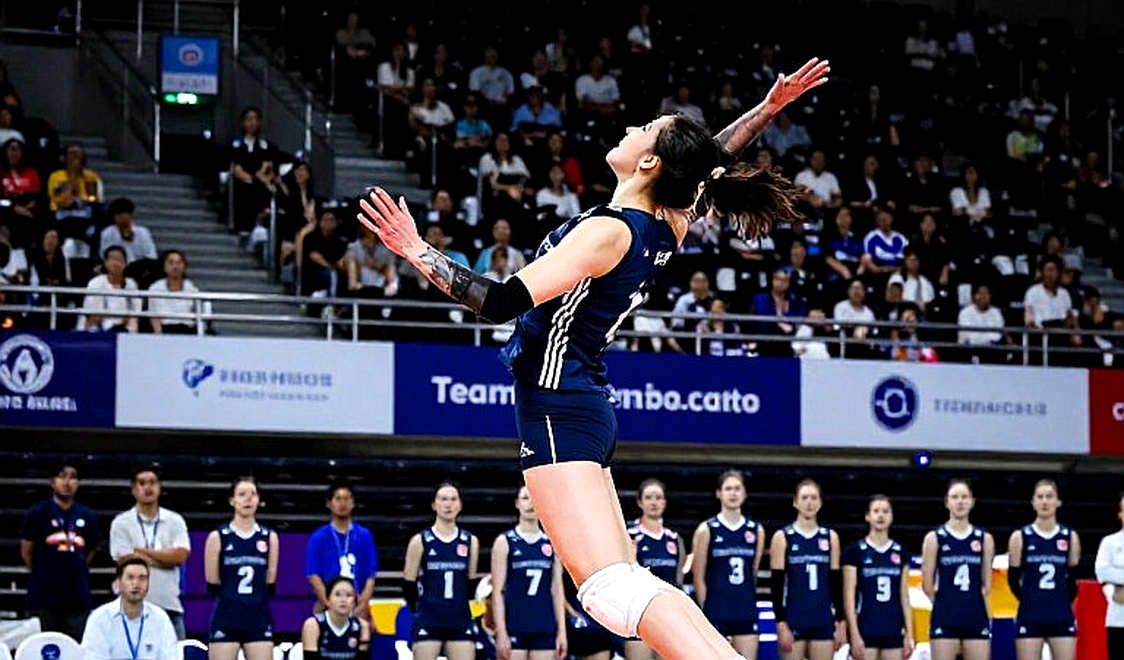
That is the most valuable technical signal in the entire group-stage dataset: against the strongest opponent, the share of Quynh Huong's points coming from blocking and serving rose rather than fell. A pure volume hitter who lives on the pass would trend the other way — when the reception line breaks under serve pressure, their points collapse. Quynh Huong, at least across three group matches, showed she is not wholly dependent on the pass to create points.
That is a strong signal. But it is still only a signal, built on three matches, only one of which came against a genuinely elite opponent. Three block points in one match does not prove a settled skill. It proves the skill exists.
Vietnam's plan and its price
Reading how Vietnam organised its attack in the group stage reveals the tactical direction for the quarterfinal. It is a system built on reception, prolonging rallies, and spreading the load.
Spreading the load is the clearest objective. On the team scoring list, Quynh Huong leads with forty-six, Bich Thuy follows with thirty-eight, Tra My with thirty. Senior Thanh Thuy — still regarded as the team's anchor — no longer carries the sole scoring burden. The most accurate reading of this eighteen-year-old is not that she replaces Thanh Thuy, but that she adds another exit for the attack. In volleyball terms, that stretches the opponent's block to open space for other hitters.
I think every contract is a journey home – some return to their hometown, others look for a new one.
In theory this is the right choice against a physically superior opponent. You cannot trade power blows with a block that is taller at almost every position. You must prolong rallies, force errors, and exploit the points that come from blocking and serving — things that do not demand the height of a spike through the block.
But it is also the hardest style for this particular team to execute. Why? A reception-first system collapses if the reception line is unstable, and the reception line is exactly where China's serve will aim.
China scored three direct serve points in one group match and five in the other. Those serve points are not just points — they break the opponent's attacking structure. Every strong serve into the primary receiver forces the setter outside the ideal zone, narrows the attacking menu, and leaves hitters facing a block already set up.

If China's serve drives Vietnam's perfect-pass rate down, every plan to prolong rallies disappears. The team will be forced into simpler, more predictable attacking options, and blocked more often.
China does not attack with one blade
There is a difference in kind that every comparison must remember.
Vietnam is building a system around the idea of adding one more exit. China operates a system that already has several exits. In other words, that side has no single hitter the opposing block can isolate and neutralise.
In two group matches China scored sixty-two points each. But the important thing is the structure: seven to ten block points in a match, and an attack distributed evenly across several hitters. When one hitter is read, they rotate the ball elsewhere. That is why several of their hitters can post different totals while the team retains overall efficiency.
Zhuang Yushan is the most mentioned name with thirty-three points in the group stage. But Tang Xin and Wu Mengjie also number among the hitters capable of carrying the load. A team with three hitters who can all score creates almost the inverse problem of a team with only one.
Against Kazakhstan, China's block scored ten points. Ten block points in a match is a very high figure at this level, and it says two things: a height advantage and good situational reading. Together with five direct serve points in the same match, this side owns a weapon Vietnam cannot answer with the same type.
This is the biggest difference between the two teams in the coming quarterfinal. China does not need an outstanding individual to win; Vietnam needs an outstanding individual just to keep the match within reach. Those are two entirely different kinds of pressure.
The numbers nobody prints
Reading the ASIAD 2026 group-stage stat sheet, one thing made me pause longer than anything else.
The sheet has points, player names, a scoring ranking. But it has no spike attempts. No attack errors. No times blocked. No perfect-pass rate. No service errors.
For a hitter, all of these matter more than the total.
Suppose a hitter finishes the group stage with forty-six points. If she needed one hundred and twenty spike attempts to get those thirty-eight attack points, the story is entirely different from a case where she needed ninety-five. And if, across those attempts, she committed fifteen attack errors and was blocked ten times, her spike efficiency would be far lower than the impression created by the figure forty-six.
That is not a pessimistic assumption. It is how every developed volleyball nation reads statistics. Total points measure volume. Spike efficiency measures quality. The two rulers can point in opposite directions.
I once sat in Moscow, in a packed press room, and mispronounced a player's name three times in the first half. Moscow is not just where I got a player's name wrong; it is where I learned to listen to a person. I spent the following month rewatching footage and noting pronunciations in IPA. During that process I noticed only two of thirty-two teams had a female assistant coach. Since then I always ask: who is missing from this story?
In Quynh Huong's story, the missing person is herself. More precisely, her efficiency. The story is being told through volume, while the real answer lies in quality.
This matters even more when you look at opposition quality. Vietnam's pool contained Qatar and Hong Kong China — opponents at a clearly lower level than what China faced. Points scored against Qatar cannot sit beside points scored against Kazakhstan's block without any adjustment.
There is one more detail worth thinking about. The cited scoring list shows three Vietnamese names near the top. For a continental tournament gathering many strong sides, three hitters from one team occupying high positions is unusual. It suggests the list may have been calculated within a narrower scope than the way it is presented. I raise this as a question to verify, not a conclusion.
The rough gem is not at the bottom of the court; it is where people do not look closely. And here, where people do not look closely is the blank statistical column beside the points column.
Commercial value and competitive value
There is a question the regional sports media rarely asks, though it lies just beneath the surface of every story about a rising female athlete.
The story of Pham Quynh Huong is being told in a certain way. It leans on youth, on beauty, on leading the scoring list. All of these are real. But they belong to different value systems, and mixing them can create a distorted picture of her true competitive ability.
People call them the beautiful girls of the court; I call them the ones who open the road.
The difference is not in denying beauty. It is in determining what should be measured. A player's commercial value can soar on a good frame, a catchy headline, a top scoring ranking. Her competitive value rises only when spike efficiency, perfect-pass rate and the ability to handle pressure at decisive moments improve. Those two curves do not run together, and sometimes they run opposite.
What is worrying is not that media exploits the image of an eighteen-year-old girl. It is when a points volume is presented as evidence of a finished ability, and when commercial attention runs far ahead of the technical base.
There is an image I still carry from the pandemic years, when all competition stopped and I phoned fifteen Singaporean women footballers who had lost their jobs, one of them a defender selling bread in a hawker centre to survive. The stadium was empty, but the applause remained – it just came from people nobody writes about. Those stories never appear on a stat sheet, and they make no pretty headlines.
In Quynh Huong's case, I hope this girl is judged by efficiency first, image second. Because if the official stat sheet after the quarterfinal shows she needed one hundred spike attempts to score twelve points, the right question is not why she played worse, but why the whole team's reception line could no longer hold the ball up.
Notably, the source story does have its own balancing points. It acknowledges China holds a clear advantage. It asks whether Quynh Huong can sustain her output against the strongest block she has ever faced. That is an honest framing, and it deserves credit.
The most likely scenario, and what it leaves behind
There are three scenarios for the quarterfinal on the morning of September twentieth.
The first and most likely: China wins by a clear margin, three sets straight. Vietnam holds its structure through the first twenty points of each set, then strong serves and a dense block break the reception line, and the match drifts away quickly.
The second, harder but not absurd: Vietnam snatches a set through its own serving pressure over a short stretch, or because China rotates to manage minutes for later rounds. In volleyball, a set won against a stronger opponent usually comes from a serving run that breaks the pass, not from attack.
The third, nearly impossible but worth naming to see the limit: Vietnam wins the match. This would require three conditions at once — the reception line holding a high perfect-pass rate, Quynh Huong sustaining output against the strongest block she has faced, and China committing far more errors than usual.
In all three scenarios, one thing is worth tracking more than the result: how Vietnam distributes the ball in the first ten points. If Quynh Huong receives ball after ball in difficult situations, is blocked twice in a row, and the team keeps feeding her, that is the sign of a system with no backup plan. If the team rotates the ball to Bich Thuy and Tra My, that is the sign of a maturing system.
The most important thing in this match is not the score. It is whether a young team knows how to play without one individual carrying the whole match. An excellent eighteen-year-old hitter can carry a team through one round. Only a system carries a team through a cycle.
If Vietnam loses and Quynh Huong still scores twelve to fifteen points with positive spike efficiency, that is a far better result than a lucky win in which she is only the hero of one play. Volleyball is not a sport for isolated flashes. It is a sport for durable systems.
Four times now I have rewatched the South Korea match. Those three block points are still what make me believe in this girl, more than the forty-six points. Attack points can come from the volume of passes. Block points come from reading the situation and the timing of the jump, things that depend on nobody else on court.
Before leaving the screen, I asked myself one thing. If Vietnam's reception line holds the ball through the first twenty points, and if that eighteen-year-old blocks a spike from China's top hitter at the decisive play — would we dare call that progress, even in a defeat?
At eleven in the morning on September twentieth, when the ball is first served, all those numbers become questions. And in Asian women's volleyball, questions answered on court are usually more interesting than answers already printed on a stat sheet.