
AVC 2026: Japan and Iran Stay Unbeaten, Chinese Taipei Break Their Drought — the Road to Olympic 2028 Starts in Pool Play
**Trả lời nhanh:** Tại vòng bảng AVC Bóng chuyền nam châu Á 2026 ở Fukuoka, Nhật Bản và Iran cùng toàn thắng và không thua set nào; Đài Bắc Trung Hoa có chiến thắng đầu tiên, còn Ấn Độ chờ kết quả Oman gặp Bahrain để biết số phận. **Dữ kiện chính:** - Giải diễn ra tại Fukuoka, là vòng loại Olympic 2028 và World Cup 2027. - Yuji Nishida đạt tỉ lệ dứt điểm 82%, ghi 16 điểm; Ran Takahashi 70% với 13 điểm và 5 ace. - Poriya Khanzadeh (Iran) ghi 20 điểm ở vị trí đối chuyền; hai chủ công mỗi người 11 điểm. - Đội trưởng Chang Yu-Sheng (Đài Bắc Trung Hoa) có 6 block trong trận thắng Qatar. - Vinith Charles (Ấn Độ) ghi 19 điểm gồm các kill block; suất tứ kết phụ thuộc Oman gặp Bahrain. **Nguồn:** Tổng hợp thống kê vòng bảng AVC Bóng chuyền nam châu Á 2026 | Cross-checked: VuaBong.vn **Hỏi đáp liên quan:** - Q: Nhật Bản và Iran đã chắc suất đi tiếp chưa? A: Cả hai đang toàn thắng và không thua set nào, gần như nắm chắc ngôi nhất bảng. - Q: Ấn Độ cần gì để vào tứ kết? A: Ấn Độ phụ thuộc kết quả trận Oman gặp Bahrain để xác định suất hạng ba. - Q: Vì sao dữ liệu chiến thuật của giải còn mỏng? A: Ban tổ chức chỉ công bố tỉ lệ dứt điểm và điểm số, thiếu tỉ lệ chuyền một hoàn hảo và tỉ lệ cứu bóng.
Opening: a quiet afternoon in Fukuoka
Twenty-four minutes into the third set, Yuji Nishida took his approach from position four, jumped at close to 3.40 metres and drove the ball into Bahrain's half. The electronic scoreboard ticked over. No roar, no long celebration — just a nod from Ran Takahashi behind the three-metre line and a brief tightening of the block's arms.
That is the moment from the 2026 AVC Men's Volleyball Asian Championship pool stage in Fukuoka that stayed with me most clearly. A procedural rally. Yet it belonged to something much larger. According to the statistics released after the pool round, Nishida finished with an 82 per cent spike success rate and 16 points. Ran Takahashi hit 70 per cent with 13 points, plus five aces directly from the service line.
Those numbers do not exist in a vacuum. They belong to a tournament with a very specific function: a direct qualifier for the 2028 Olympic Games and the 2027 Volleyball World Cup. A set won in Fukuoka carries a different weight from a set won in a summer friendly.
And as with every major pool stage, the most interesting part is usually what does not get recorded.
Context: a pool stage carrying two tickets
The 2026 AVC Men's Volleyball Asian Championship is in its pool stage, with Japan hosting in Fukuoka. It is a high-prestige event within the AVC system and simultaneously a qualifying event — results here feed directly into the road to the 2028 Olympics and the 2027 World Cup.
Pool scoring follows the international standard: a 3-0 or 3-1 win earns three points, a 3-2 win earns two, a 2-3 defeat still earns one. Pool winners advance directly. The remaining places — particularly the third-placed slots — are decided by comparing records across pools. That comparison mechanism creates a different kind of pressure from the pressure inside the arena: some teams must wait for other results before knowing their fate.
The field this year brings together Japan, Iran, Chinese Taipei, India, Australia, Bahrain and Qatar. In terms of tiers, Japan and Iran sit in the title-contender bracket. Chinese Taipei, Bahrain and Qatar belong to the medal and quarter-final bracket. India occupy a grey zone — genuine potential, but dependent on external results. Australia sit in the second tier in this event's context.
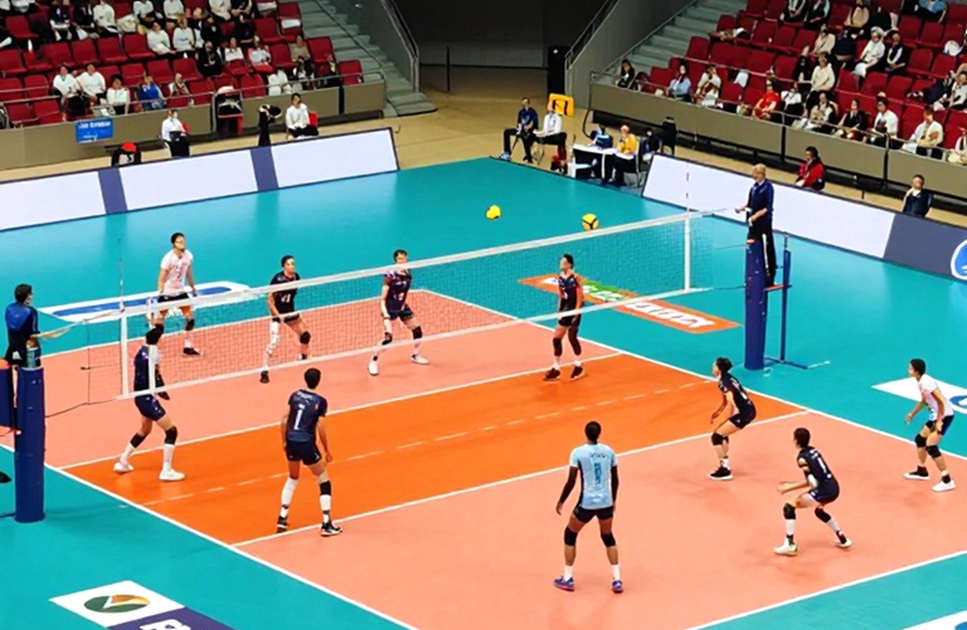
One point needs stating from the outset: this is the men's game. There is no beach branch, no women's competition within the scope of the event being analysed. That matters, because I will return to it later when discussing the data vacuum — a problem that Asian women's volleyball has lived with for years.
On scheduling pressure, current density sits at pool-stage level and is therefore relatively light. Japan play at home in Fukuoka and face almost no long-haul travel burden — no small advantage at national-team level, where recovery windows are routinely cut short by flights and time-zone shifts. The remaining visiting teams must adapt to the climate, the floor and the competitive rhythm in Japan inside a narrow time frame.
Based on my experience tracking Asian pool-stage matches across several seasons, home advantage at this level rarely shows up as lopsided set wins. It shows up in how decisive moments late in a set are handled — where a home crowd creates a psychological pocket of silence for the visiting side.
Core: what the statistics say and where they stay silent
Japan: individual efficiency at the ceiling
Japan came through the pool unbeaten without dropping a single set. That signals stability, but the more revealing element lies in the scoring structure.
The most striking feature of Japan's pool campaign is that almost the entire attacking output came from two wing hitters, rather than from a genuinely diversified distribution system. According to post-round statistics, Nishida recorded an 82 per cent spike success rate and 16 points. Ran Takahashi hit 70 per cent with 13 points, adding five aces directly from the serve — a figure showing Japan's serving pressure was not merely disruptive but outright scoring.
An 82 per cent rate from a wing position is very high in modern men's volleyball. At continental level, where opposing blocks are usually organised around reading the setter, an attacker above 80 per cent generally means they were repeatedly fed the ball in favourable situations — in other words, Japan's first pass worked well, or Bahrain could not generate enough serving pressure to break their attacking rhythm.
This is where a methodological problem appears. The published statistics contain no perfect-pass rate, no dig rate, and no blocks-per-set figure for most matches. In other words, we know the end of the attacking chain but not how well the chain began.
Another detail is worth noting: beyond Nishida and Takahashi, data on Japan's remaining attackers is essentially blank. Captain Yuki Ishikawa appears in the key-personnel role, but no individual attacking metrics were released for him. For a team rated as the number-one title contender on home ground, the absence of data on the second group of hitters turns any conclusion about squad depth into speculation.
What can be stated with confidence: Japan are winning on execution efficiency, and that efficiency is measured by numbers attached to two names. That is a solid foundation for pool play, but a fragile structure if a later opponent knows how to split the block.
Iran: power from the opposite position
Iran also finished the pool unbeaten without dropping a set. Unlike Japan, their scoring structure shows a clearer positional distribution.
Poriya Khanzadeh, playing opposite, scored 20 points — the highest output on the team. Iran's two wing hitters contributed 11 points each. This structure produces a specific kind of balance: one primary weapon at opposite, and two secondary weapons on the wings, enough to prevent an opposing block from committing entirely to one side.
In modern men's volleyball, the opposite is typically designed to be the heaviest attacker in the team, the player who receives the ball in out-of-system situations — when the first pass has already broken down. Khanzadeh scoring 20 points shows Iran use him as an escape valve, and that valve worked efficiently against pool-stage opponents.
The difference between Japan and Iran lies in where the attack originates: Japan rely on the efficiency of two wing hitters, while Iran rely on one heavy opposite supported by two balanced wings. Neither model has yet been tested against a block of genuine quality.
It is also worth adding that Iran dropping no sets in pool play is an early-warning signal for later opponents. In recent Asian tournaments Iran have tended to start slowly and accelerate. This time they started by imposing themselves.
Chinese Taipei: a first win and the name behind it
Chinese Taipei claimed their first win of the tournament, with the standout performance coming from captain Chang Yu-Sheng's blocking: six blocks in a single match, including direct scoring blocks against Qatar. Their wing hitters also contributed meaningfully to the score.
Six individual blocks in one match is a notable figure at national-team level. It indicates two things. First, Chinese Taipei's blocking system read Qatar's attacking direction well enough to put blockers in the right place. Second, those points came from direct scoring blocks — the ball died at the net, with no need for back-court defence.
Chinese Taipei's first win is worth more than the three points it delivered: it is an assertion that this team has been seen after years of being placed on the periphery.
But analytical distance is required. The opponent in that win was Qatar — a quarter-final-bracket team, not a leading contender. There is no first-pass rate, no count of blocks beaten, no data on Chinese Taipei's out-of-system attacking. One good blocking match does not constitute a trend.
India: a captain carrying the entire attack
India's brightest point in the pool stage was captain Vinith Charles with 19 points, including kill blocks. A captain leading both in scoring output and in decisive moments at the net is a sign of a group clinging to a single axis.
This raises a sustainability question. When one attacker accounts for the bulk of a team's attacking output, later opponents can adjust their block and defensive positioning to pull that player out of their comfort zone. At Asian level, that adjustment often takes only one set.
And India's fate at this tournament is not entirely in their own hands. Their quarter-final berth depends on the result of Oman versus Bahrain — that result will determine their final standing in the third-place comparison. This is a direct consequence of cross-pool comparison: some teams finish pool play without knowing whether they continue.
For India, the pool-stage problem was not the absence of a star, but the absence of a second option in the attacking line.
The rest of the field and what the data does not provide
Australia, Bahrain and Qatar moved through the pool stage as counterparts. Bahrain were the victims in the match where Ran Takahashi scored five aces. Australia were the opponents in the match where Nishida hit 82 per cent. Qatar absorbed Chang Yu-Sheng's six blocks.
Looking at that list, a methodological issue becomes obvious: every standout pool-stage metric was produced against weaker opposition. The published statistics apply no opponent-strength adjustment. That means Nishida's 82 per cent, Takahashi's 70 per cent and Khanzadeh's 20 points have not been tested under the pressure of a top-tier block and back-court defence.
The list of data gaps is longer than the list of available data. No perfect-pass rate. No dig rate. No blocks-per-set for the tournament — only one individual bright spot in Chang Yu-Sheng's six. No attack-share breakdown by position. No data on out-of-system attacking, the situation where the first pass has broken and the team must handle a second ball.
This is the kind of gap that forces every deep tactical analysis to stop at the level of hypothesis. And this is where I need to return to the point raised in the context section.
The contrarian angle: a flawless scoreboard often conceals a fragile structure
A widespread belief among followers of Asian volleyball holds that an unbeaten record without dropping a set is a marker of a team superior in every dimension. I think that belief is half right.
For Japan and Iran, dropping no sets reflects a genuine gap in class against pool-stage opponents. But it also takes away the most valuable thing in a preparation phase: difficult situations. A team that has never been pushed into a fifth set in pool play enters the knockout stage without internal data on how it responds when trailing 20-23.
Second, the attacking models of both leading teams share a concentrated structure. Japan score through two wing hitters. Iran score through one heavy opposite and two wings. In pool play that concentration is harmless because opponents cannot punish it. In the knockout stage, where video analysis is used exhaustively, it becomes the clearest target to exploit.
Third, the third-place comparison mechanism creates a type of pressure the scoreboard does not reflect. India could win their final pool match and still be eliminated. The team best prepared for that scenario will not be the strongest team, but the one whose coaching staff proactively built contingency plans.
And finally, there is a point I cannot overlook when reading these statistics. The men's event in Fukuoka supplies spike success rates, point totals and ace counts — and despite its gaps, it remains a structured data package. Meanwhile, many Asian women's volleyball events at the same level finish without even a published spike success table. The gap in data quality between the two competitive systems does not reflect a gap in the professional level of the athletes.
The worrying thing is not that the numbers in Fukuoka lack depth, but that we have grown used to treating that level of data as the standard rather than the floor.
Conclusion: what the next round will verify
Japan and Iran enter the knockout stage with perfect records and standout individual metrics. Chinese Taipei enter with a first win and a captain in strong blocking form. India enter — or do not enter — depending on the result of a match they are not playing in.
The pool statistics tell us who is scoring. They do not tell us who will keep scoring when the first pass breaks. That is the only test that matters in the knockout stage, and it is the test the current data package cannot answer.
From the stands in Fukuoka, I learned that a strong team is not measured by flawless set wins, but by how it stands firm when the first touch does not go as planned.
People say Asian men's volleyball lacks tactical depth. I say they have not been patient enough to read the numbers that were never published.
And if the pool stage is only a comma in a longer story, then the real question of this tournament is still waiting to be answered in Fukuoka.
Appendix: terms to know
- Spike success rate: the percentage of attacking attempts that end in a direct point.
- Opposite: the attacker positioned diagonally from the setter, usually the heaviest attacker on the team.
- Captain: the on-court leader, for example Yuki Ishikawa of Japan, Chang Yu-Sheng of Chinese Taipei.
- Kill block: a block that directly scores a point.
- Ace: a direct point from the serve.