
WTT Feeder Linz 2026: England Borrows Doubles Partners, and That Is the Real Story of the Event
**Câu trả lời cốt lõi**: Tại WTT Feeder Linz 2026, Anh chỉ có hai tay vợt trong bảng đấu chính là Tin-Tin Ho (hạng 80 thế giới) và Connor Green (hạng 122 thế giới). Điểm đáng chú ý nhất là hai trong ba cặp đánh đôi của họ dùng đồng đội ngoại quốc, trong khi cặp duy nhất toàn người Anh lại là hạt giống số một đôi hỗn hợp. **Dữ kiện chính**: - Tin-Tin Ho được xếp hạt giống số một ở đôi nữ và đôi hỗn hợp, hạt giống số bốn ở đơn nữ. - Connor Green hạng 122 thế giới, hạt giống số sáu đơn nam và hạt giống số năm đôi nam. - Ho đánh cặp với Kukulkova (Slovakia); Green đánh cặp với Zalewski (Ba Lan). - Cặp Ho và Green vô địch đôi hỗn hợp tại Düsseldorf tháng Ba và đang nhắm danh hiệu thứ hai. - Cặp xuyên liên đoàn hợp lệ ở WTT và giải vô địch thế giới, nhưng không hợp lệ ở Thế vận hội. **Nguồn**: Bản xem trước bốc thăm WTT Feeder Linz 2026 do kênh truyền thông Table Tennis England phát hành | Cross-checked: VuaBong.vn **Hỏi đáp liên quan**: Hỏi: Vì sao Anh không dùng cặp đôi toàn nội địa ở Linz? Đáp: Có thể do thiếu chiều sâu đôi nội địa ở tầng Feeder hoặc do chính sách hợp tác xuyên liên đoàn, và dữ liệu hiện có chưa đủ để kết luận. Hỏi: Kết quả nào đáng theo dõi nhất ở Linz? Đáp: Trận vòng 32 đơn nam của Connor Green trước tay vợt vượt vòng loại, trong 48 giờ đầu của bảng đấu chính. Hỏi: Cặp đôi hỗn hợp của Anh có dự Thế vận hội theo cấu hình hiện tại không? Đáp: Không, vì Thế vận hội yêu cầu cặp đôi phải cùng một Ủy ban Olympic quốc gia.
On the draw sheet pinned outside the competition hall in Linz, Austria, there are two names carrying English passports. Tin-Tin Ho, world No. 80. Connor Green, world No. 122. Each is entered in three events. Read that far and nothing looks unusual: a mid-tier association will normally pile its players into multiple events to maximise ranking points.
Then I looked across to the doubles columns. Ho's women's doubles partner is not English. Green's men's doubles partner is not English either. A Slovak player partners Ho. A Polish player partners Green. The only all-English pair in the entire draw preview sits in the mixed doubles — and that pair happens to be the top seed, chasing a second consecutive title after winning in Düsseldorf in March.
WTT Feeder Linz 2026 looks small at first glance. Looked at more closely, it is a structural photograph of English table tennis — and the photograph is not flattering in the way the association's own media channel would like you to believe.
An event at the bottom of the pyramid
Feeder is the lowest tier in the World Table Tennis system. Below it there is nothing. Above it, in order, sit Contender, Star Contender, Champions and Grand Smash. A Feeder champion collects roughly 125 ranking points — a figure that needs checking against official ITTF and WTT documentation before being quoted as a hard fact. The total prize pool is typically in the low tens of thousands of dollars. Matches are streamed free on the WTT YouTube channel. The broadcast rights value of a Feeder event is close to zero.
The only source I have is a draw preview published by Table Tennis England's own media channel. It is a primary source in the strictest sense: the association talking about its own players. It is also a media channel with an interest. The facts about English entries, seeds and rankings are close to entirely trustworthy. The interpretation deserves suspicion. And the rest of it — the wider draw, the shape of the field, current form — simply does not exist in the source.
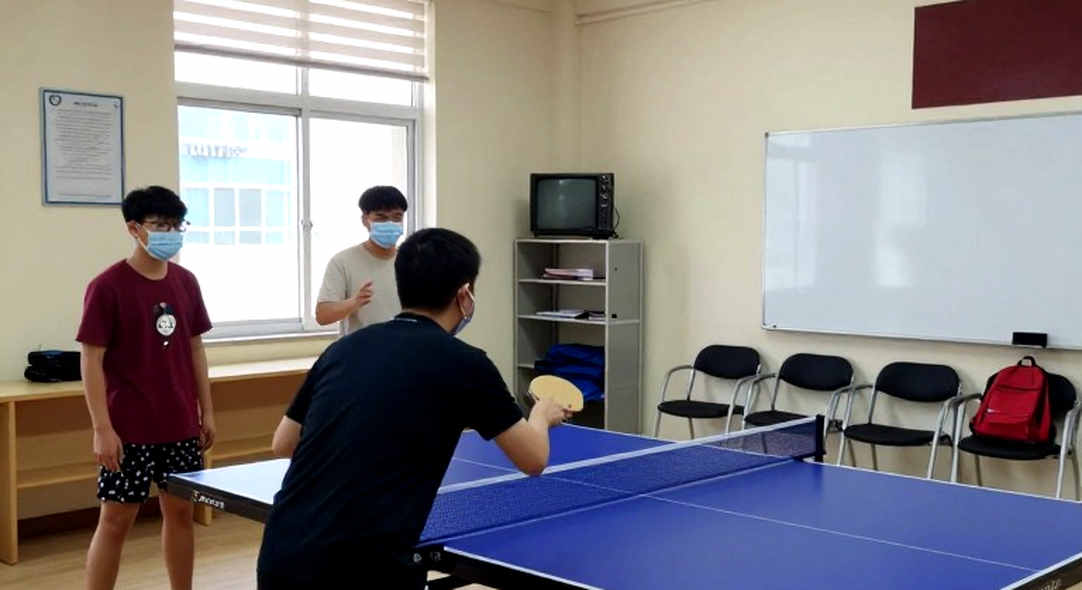
I have sat in halls like this many times. A Feeder event in Europe usually runs inside an ordinary sports hall: eight to twelve tables in rows, plastic seating for a few hundred spectators, and a sound so bare that you can hear a player breathing at the far table. No giant screens. No roaring stands. What is there is table tennis stripped to its essentials, and a ranking table waiting to be topped up.
That is why I read Feeder draws before I read Grand Smash results. At the lowest tier you see the real structure of federations — who is investing, who is borrowing, and who is simply filling a slot. Kazan did not kill old football; it exposed the slow ones. Linz will not kill English table tennis either. It will simply photograph it.
Cross-association doubles: legal here, useless at the Olympics
This is the most important detail in the entire preview, and the preview never mentions it.
Tin-Tin Ho plays women's doubles with a Slovak partner. Connor Green plays men's doubles with a Polish partner. Both pairings are legal at WTT events and at the World Table Tennis Championships. At the Olympic Games the rules are different: the mixed doubles is limited to a single pair per National Olympic Committee, and doubles matches inside the team event must be same-nationality pairings. Cross-association pairs cannot appear.
Which means the two doubles entries I am looking at on that board in Linz cannot be a rehearsal for Los Angeles 2028. They are points vehicles and experience vehicles. For an association like England, that is strategically sensible in the short term.
But it also exposes a structure: two of England's three doubles routes at this event depend on players from other associations. That is a dependency, and every dependency is a break point when a variable moves. A partner can change schedules, get injured, lose form, or simply choose to pair with someone else at the next event. When that happens, England does not lose a match. England loses an entire main-draw slot.
If this is deliberate policy — the kind of bilateral cooperation between smaller federations that improves main-draw access for both sides — then it is smart in the short term. If it is the consequence of insufficient domestic doubles depth at this tier, then it is a far more serious structural problem. The preview does not say. And the silence is itself information.
The host wildcard and the floor of the field
In the first round of the women's singles, Tin-Tin Ho faces an Austrian host player ranked No. 777 in the world.
Let me be blunt: a world No. 777 walking straight into the main draw of an international event is not an achievement. It is a host-nation wildcard — an entirely normal governance mechanism within the ITTF and WTT system, used to give domestic players international exposure. That mechanism does two things at once: it opens a door for the host player, and it lowers the quality floor of the event.
For Ho, this is an easy opener. But the easy opener carries a familiar trap: a No. 777 player competing at home, in front of home spectators, with nothing to lose, already familiar with the table and the ball. My experience of watching matches at this tier says the real risk in games like this is not technical. It is adaptation. A seeded player who walks in expecting a three-game win and gets dragged to a fifth game has already spent a slice of physical capacity that should have been saved for two more events.
The trap called qualifier
In the men's singles, Connor Green enters as the sixth seed. His round-of-32 opponent is a qualifier — an identity not yet fixed at the time the preview was published.
This is the classic trap of every Feeder event, and it has nothing to do with ranking.
A qualifier has already played at least one match, sometimes two or three, on those very tables in that very hall. They are used to the lighting, the draught, the bounce, even the echo of the building. The sixth seed, by contrast, walks into their first match completely cold. In table tennis, the gap between a world No. 122 and a world No. 200 who has come through qualifying is far smaller than the gap the words seeded and unseeded suggest.
And one thing needs stating plainly: there is not a single line of head-to-head data in the source for any of the two English players' matches. No win rates, no recent results, no injury information, no physical data. Every seed-based forecast is exactly that — a seed-based forecast.
The champion-decoding effect
The mixed doubles pair of Ho and Green are the top seeds. That status comes from the Düsseldorf title in March, and they are chasing a second crown.
There is something Feeder-level players rarely account for: winning a title at your own tier turns you into a video target. Every pair in the draw can find footage of your matches from the previous event, slow it down, note your service structures and receive patterns, and find your habitual rhythms. At Feeder level, where the technical gap between pairs is narrow, being decoded in advance can be the difference between a quarter-final place and a second-round exit.
Champions always get studied harder than unknown players. That is the price of a title, and it appears nowhere in how the preview describes this pair.
Points concentrated in a single March event
The WTT ranking mechanism runs on a rolling 52-week cycle: points earned at an event expire after exactly one year unless replaced by new results.
The Düsseldorf title came in March. That means the bulk of Ho and Green's mixed doubles points currently sit inside a single event. Concentrated points, no diversification. When that defence window opens, if the pair have no equivalent replacement results, their seeding at Contender level and above softens. And when seeding softens, draws get harder, and the downward spiral begins.
This is the kind of risk no one writes about, because it produces no images. But it is real, and it is structural rather than emotional.
Two names, and the gap in the middle
Across the entire draw preview, exactly two English players are named. A woman of 27 or 28, in the closing phase of her prime. A young man of roughly 20 to 22, on the rise.
There is no third name.
A draw sheet cannot prove the depth of an entire development system. But it is the only signal I have, and it points one way: English table tennis at this tier has one anchor and one seedling, with the space between them empty. No middle layer. No cohort of 24-to-26-year-olds competing for main-draw slots.
The entire competitive expectation of the association at Linz rests on one person: Ho is seeded first in two events and fourth in a third. When an association places its bet on a single veteran, that is the textbook warning pattern of a generational gap. And it only becomes a problem on the day that player can no longer compete.
On Green's side, the arrangement looks healthier: three events, seeded in two of them. That is a sign of investment. But a European U21 doubles bronze — a genuine junior-to-senior conversion marker — is a doubles marker, and a much weaker signal than a singles breakthrough.
The real opponents at this tier: India, Luxembourg, and a familiar face
Applying the China versus the rest of the world frame to a Feeder event is a methodological mistake. Chinese players almost never appear at this tier — entirely normal within the WTT system. The real competitive axis in Linz is European mid-tier versus Asian second-tier versus emerging federations.
In the women's doubles, the round-of-16 opponents of Ho and her Slovak partner are an Indian pair. Indian women's table tennis has been ascending for years, and an Indian pair walking into a match against the top seeds is a standard test between a rising federation and an established mid-tier one. But the scale matters: one pairing cannot support a conclusion about the depth of a whole national programme.
In the men's doubles there is a more interesting detail. Green's round-of-32 opponents are a Luxembourg pair featuring a player who partnered Green himself and won a European U21 doubles bronze in June. The preview calls it a familiar opponent.
Familiar sounds like an advantage. It is not. If Green knows the other man's game, the other man knows Green's — in more detail than anyone else in the draw. The informational advantage here is symmetrical, not one-sided. Matches like this tend to be scrappy, drawn out, and settled by small details that cannot be prepared for.
Luxembourg's presence in a men's doubles main draw also says something about the ecosystem: small federations are using cross-association pairings as a low-cost route into main draws and ranking points.
The economics of a Feeder event: close to zero
Not one equipment brand, sponsor, prize-money figure or ticketing detail appears in the source.
At this tier there is no equipment-market reaction. There is no commercialisation. Feeder events exist on association competition budgets and are streamed free on YouTube. The media value of a Feeder title lies mainly in the ranking points it adds and a couple of headlines on the association's own website.
And that is why the preview I am reading exists at all. It is the media output of an association, written for a home audience, serving a specific purpose: keeping English table tennis visible between major events.
There is one contextual detail I must flag as pending verification. If the reports that London will host the 2026 World Team Table Tennis Championships are accurate, then every English result this year carries far more strategic weight than the preview itself acknowledges. A home World Championships is the single biggest commercial and participation catalyst of a cycle. I have no official ITTF confirmation, so I leave it here as a variable to track, not a conclusion.
The contrarian angle: I may be reading this wrong
I may be wrong, and I should say where.
My reading treats the borrowing of foreign partners as evidence of a hole. There is another reading, and it may be truer: at Feeder level, national identity is not a meaningful unit of measurement. The units are main-draw access and ranking points. If an association can pair its player with a partner strong enough to climb to top seeding, that is optimisation, not dependency. European table tennis has operated this way for a long time, and the people inside know it better than I do.
Another hole in my argument: two names on a draw sheet do not measure the depth of a system. There may be three or four other English players competing at continental events the same week, or injured, or in transition. I do not have that data.
People called me a traitor in 2026, but I was simply looking one step further ahead than an old teammate. That lesson taught me something: going against the crowd is easy, taking responsibility for what you say is hard. So I state the part I am unsure about. A walkout is never as hateful as a promise not kept — and an association that promises a next generation and does not deliver is in the same category.
What to watch
There is one piece of data I am waiting for, and it will arrive within the first 48 hours of the main draw: the result of Connor Green's round-of-32 men's singles match against the qualifier. If he wins cleanly, that is a positive signal about adaptability. If he is dragged into a long match, or loses, then the men's field I called shallow will have revealed a different problem — Green's problem, not his opponent's.
In the women's doubles, the pairing of Ho and her Slovak partner is a genuine unknown. They are top seeds, yet no shared match record has been published. Nobody knows how many matches they have played together, how well they read each other, how they split the court. The results will speak, and they will speak quickly.
And beyond Linz, the biggest question is whether English table tennis can produce that third name in a main draw before its single anchor passes her peak.
I am old now, but I am fast enough to understand that the slow ones disappear. At Feeder level, nobody disappears because they lost a match. People disappear because nobody is standing beside them when the match begins.